The Past Finds New Expression in Restaurant Potong’s Reopening Menu

Updated: Jul 23

Few chefs have shaped contemporary perceptions of Thai cuisine as decisively as Pam—Pichaya Soontornyanakij. The chef behind Restaurant Potong was named Asia’s Best Female Chef 2024 by Asia’s 50 Best Restaurants, followed by the World’s Best Female Chef title from The World’s 50 Best Restaurants in 2025, while The Best Chef Awards presented her with Three Knives. These accolades have placed her firmly among the most celebrated chefs in Thailand, yet they tell only part of her story. What continues to distinguish Chef Pam is her ability to express heritage, passion and creativity through food without allowing any of them to become empty rhetoric.

Born and raised in Bangkok, Chef Pam initially considered a career in journalism before her interest in food drew her in another direction. She trained at the Culinary Institute of America and refined her craft in New York, working under renowned chefs before returning to Thailand. Projects such as The Table and Smoked established her presence on Bangkok’s culinary scene, but it was the opening of Restaurant Potong in 2021 that allowed her to articulate her vision in its most complete form.
Potong occupies the century-old building in Bangkok’s Chinatown that once housed her family’s traditional Chinese medicine business. Rather than using that history as decoration, Chef Pam made it the restaurant’s foundation. Her philosophy of “five elements and five senses” brings together her Thai-Chinese ancestry, personal memories and contemporary culinary techniques, while ingredients sourced from across Thailand connect that family story to a much broader landscape. Following a renovation, the restaurant reopened on 16 June 2026 with a new menu and a more considered dining environment.

The experience begins in the lobby, where guests are led to a waiting corner and welcomed with a refreshing towel and house-made kombucha. Once the table is ready, the host guides them upstairs into the redesigned dining room. The reduction in seats has created more breathing room and privacy, correcting the sense of compression that previously accompanied a full service. The room now feels calmer and more intimate, although its spiritual heart remains unchanged. The family shrine continues to occupy a central position, serving as both a visual anchor and a reminder of the Chinese heritage that runs throughout Potong.

Once everyone is seated, the evening begins with an envelope placed on the table. Inside is a note written by Chef Pam to her great-grandparents, thanking them for the heritage and legacy they left behind while expressing her commitment to keeping that inheritance alive in her own way. It is an intimate gesture, but also a clear statement of intent. Potong is not attempting to reproduce the past exactly as it was; it is exploring what happens when memory is inherited, examined and reinterpreted by another generation.
The principal ingredients are then brought to the table, offering a first glimpse of the menu ahead. For the reopening, these include tiger prawns from Nakhon Si Thammarat, orange mud crabs from Ranong and oysters from Surat Thani. Their provenance reflects Chef Pam’s continued support for local fisherfolk, while their prominence throughout the menu ensures that regional Thai produce remains an essential part of the restaurant’s narrative rather than a passing detail.


The meal opens with New Life, ordinarily presented as Squid and Squid Ink Dip. For guests with a squid allergy, the squid is replaced by toddy palm fruit cut into neat rectangular pieces and served in a clear brine. Its bouncy, gently chewy texture makes it a remarkably fitting substitute. Alongside it is a coconut cream dip adapted from the original squid ink and coconut cream sauce. Creamy, savoury and sweetly acidic, it recalls the balance of tom kha. The toddy palm becomes more than a reluctant alternative, emerging as a convincing opening course in its own right.


From this bright beginning, Preserving turns towards Yunnan through cured ham from Jianchuan and rose-petal sorghum rice wine. The ham rests on house-made mayonnaise toast beneath translucent slices of cured lard infused with the floral spirit. Salt from the ham meets the richness of the mayonnaise, while the crisp bread provides contrast before the lard dissolves across the palate. A vegetable broth served alongside brings restraint to an otherwise indulgent composition. Every component performs a clear role, revealing the careful calculation behind the course without making it feel overly clinical.

The third course, Generation, presents Pad Thai in a strikingly distilled form. A tiger prawn from Nakhon Si Thammarat is draped across a single sheet of rice noodle patterned to resemble the Thai national flag, accompanied by a wedge of lime and mixed Thai rice tea. Despite the abstract presentation, its flavours remain faithful to the familiar dish: savoury, sweet and tart, with the prawn contributing clean sweetness and satisfying density. The tea clears the palate, quietly preparing it for the deeper flavours to come.

At this point, guests who have selected the additional Legacy experience are served Fujian Pork Noodle Soup with Kombu Caviar. Tender pork is rolled inside wide white rice noodles and placed in a cloudy, slowly cooked broth. The noodles retain a gentle chew, while the pork yields easily and the stock carries a natural underlying sweetness beneath its savoury body. Kombu caviar provides salinity and small bursts of texture, sharpening the comforting softness of the dish. Legacy will return later in the menu through another preparation, extending its reflection on preservation and the use of an ingredient beyond one course.

The progression is then pleasantly interrupted by the presentation of a whole five-spice roasted duck sourced from Chachoengsao. Plump and lacquered, it glistens beneath the dining-room lights, its glazed skin offering a preview of the courses to come. The appearance of the entire bird provides a moment of theatre, but it also establishes Potong’s approach to using the ingredient more completely. Different parts of the duck are transformed into separate preparations, allowing it to become a recurring thread rather than a single grand centrepiece.

Before the duck returns to the table, Respect shifts the menu back towards the sea through orange mud crab from Ranong. Coriander and spring onion steamed rice is mixed with green mango chilli sauce, topped with sweet crab meat and finished with a generous layer of steamed crab fat. The aromatic rice carries the freshness of the herbs, while the sauce introduces the bright heat and acidity associated with Thai seafood sauce. The crab meat contributes sweetness, and its fat deepens the composition without smothering it. Rather than mixing everything together, each spoonful is best gathered through all the layers, allowing the rice, sauce, meat and fat to retain their individual characters while arriving together on the palate.

The seafood narrative continues with Memories, featuring oysters from Surat Thani resting over vermicelli in Potong’s golden broth. The oyster is precisely cooked, remaining plump, juicy and naturally sweet, while the slippery noodles retain just enough chew. The savoury-sweet broth brings the elements together without overwhelming the delicacy of the shellfish. It is a quietly controlled course that relies on careful cooking and textural balance rather than elaborate embellishment.

For those having the additional Legacy courses, duck next appears as a house-made sausage prepared from parts of the Chachoengsao bird not used in the principal roasted duck course. The sausage sits on a thin, tortilla-like round of dough, topped with duck foie gras and finished with sweet and savoury Peking duck sauce. The construction suggests a playful meeting between Mexico and China, although the combination remains coherent rather than gimmicky. Richness builds through the sausage and foie gras, while the thin dough turns it into a compact course intended to be lifted and eaten by hand. Together, the Fujian pork noodles and duck sausage form Legacy, an add-on progression woven into the wider menu.


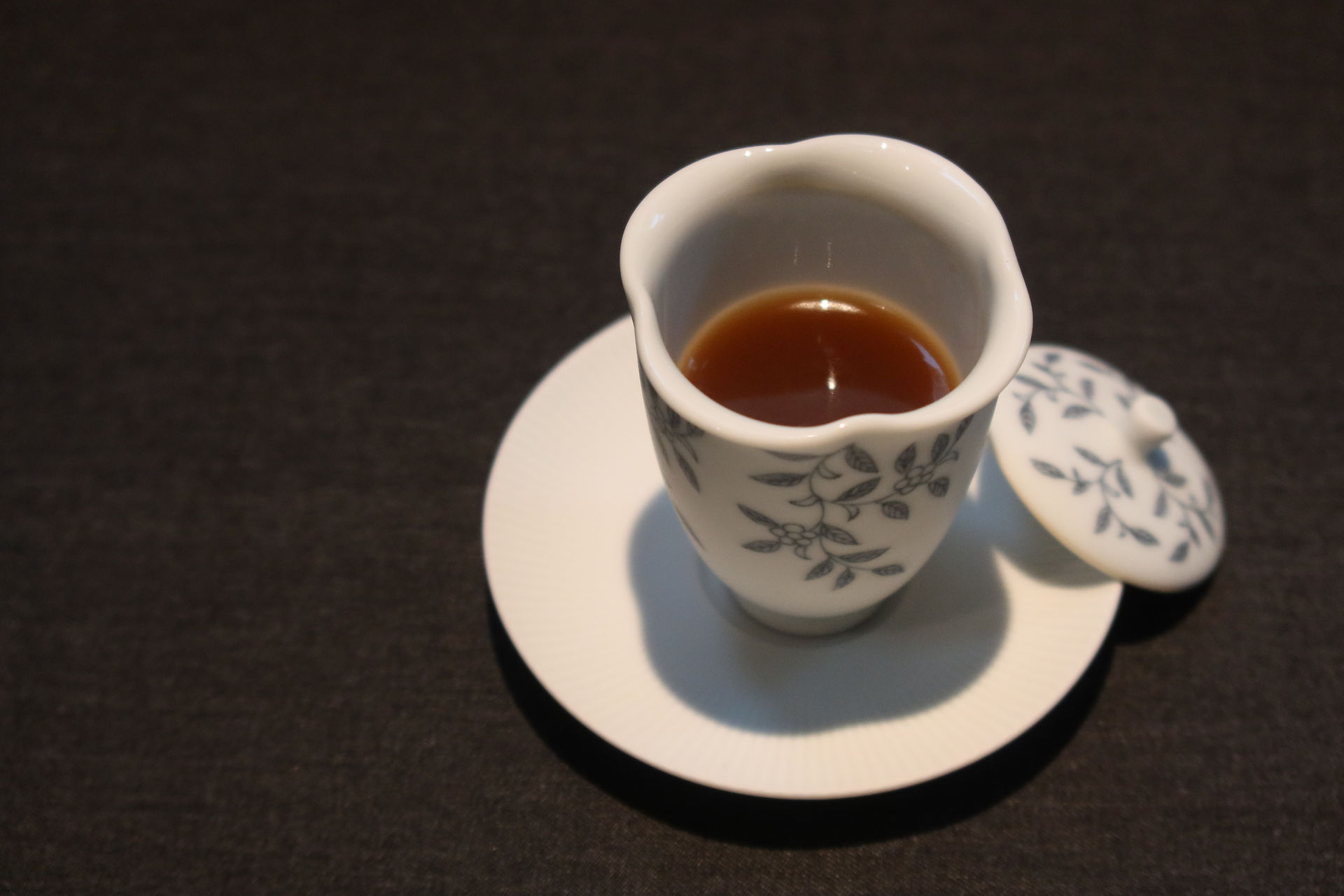
The roasted duck itself returns as Potong, appropriately becoming the course that bears the restaurant’s name. One piece is served without sauce, allowing the seasoning, flesh and crisp skin to be tasted directly, while four further pieces are dressed with duck jus. Garlic purée, a slice of porcini mushroom and bok choy complete the plate, accompanied by a small cup of mushroom soup and pickles. The unsauced portion draws attention to the precision of the cooking, before the jus adds additional depth to the remaining pieces. Earthy mushrooms and sharp pickles provide contrast, preventing the richness of the duck from becoming monotonous.


Celebrate continues the conversation between Chinese ingredients and European techniques through Fish Maw Risotto. The fish maw’s gelatinous texture allows it to absorb the savoury stock, while a mixture of colourful Thai rice retains an al dente bite, keeping the dish from becoming overly soft. Morel mushrooms lend an earthy depth, forming a natural bridge between the Chinese ingredient and the risotto format. The course demonstrates how Potong’s cultural references can intersect without either one being reduced to ornament.

The final savoury course, Together, turns towards Chef Pam’s childhood with her interpretation of Rad Nah. Minced duck replaces the customary pork, while the flat noodles carry the aroma of charcoal and a slight surface crispness. Bok choy provides freshness before the duck gravy is poured over the noodles at the table. The gravy ordinarily contains squid ink, which adds colour and marine depth, but it can be prepared without it for guests with an allergy. Chilli oil and calamansi are served on the side, allowing heat and acidity to be adjusted without disturbing the dish’s nostalgic core. It remains recognisable enough to stir familiarity, yet has been transformed sufficiently to belong within Potong’s culinary language.

Thank You provides a welcome pause after the succession of seafood, broth and duck. The santol sorbet’s bright tropical acidity cuts neatly through the richness of the preceding courses, while the fruit’s gentle sweetness and subtle tartness refresh the palate without creating an abrupt transition. Light and cooling, the course functions as more than a conventional palate cleanser. Its name gives the simple presentation an emotional purpose, expressing gratitude before the menu moves towards its final chapter.

Dessert arrives as Walls, an assortment of confectionery that returns attention to the building at the heart of Potong’s story. Chocolate mousses shaped of the Potong building and the old Potong Apothecary logo sit alongside mousse, ice cream, mooncake, gummy confectionery and kanom krok bai toey, a small pandan sweet somewhere between a pancake and a cupcake. By translating the building’s architecture and former identity into edible forms, Walls turns the family home and apothecary into the final expression of Chef Pam’s heritage. Rather than ending with a single monumental dessert, the course offers several smaller pleasures while bringing the evening back to the place where Potong’s story began.


The evening ends with a wooden mystery box containing numerous small drawers, from which every guest must choose a fortune cookie. It is a playful conclusion to a carefully structured experience, leaving the final moment partly to chance. More importantly, it brings Potong’s central idea full circle: the evening begins with a message addressed to the past and ends with a fortune pointing towards the future.

Following its renovation, Potong feels more assured in both its physical surroundings and its storytelling. The additional space gives the dining room a welcome sense of composure, while the reopening menu moves fluidly between Thai produce, Chinese heritage, childhood memories and contemporary technique. Names such as New Life, Preserving, Generation, Respect, Memories, Legacy, Potong, Celebrate and Together reveal the emotional architecture beneath the dishes, turning the meal into a sequence of ideas rather than a conventional procession of courses. Potong is therefore neither a preservation of Chef Pam’s family history nor a departure from it. It is a living continuation—one that honours what came before by allowing it to change, carrying a century-old legacy forward through Chef Pam’s distinctive and increasingly confident voice.
Restaurant Potong
Tel: +668 2979 3950
Website: https://www.restaurantpotong.com/
Instagram: https://www.instagram.com/restaurant.potong/
Location: 422 Vanich 1 Rd, Samphanthawong, Bangkok 10100
Credits
Article: Wariya Intreyonk
Photos: Wariya Intreyonk and courtesy


Comments