TAAN Bangkok's Northern Lights Brings Lanna and Siam Together


Thailand's regional cuisines have always been shaped by more than geography. Ingredients, preservation methods, local produce and generations of cooking traditions give each region its own vocabulary, yet those distinctions become particularly interesting when allowed to converse. At Northern Lights, a four-hands dinner hosted at TAAN Bangkok at Siam@Siam Design Hotel Bangkok on 2–3 October 2026, Lanna and Siam came together through the perspectives of Chef Monthep "Thep" Kamolsilp, Executive Chef at TAAN, and guest chef Rinnameth "Nan" Thaisuchat of Cuisine de Garden Chiang Mai.


Rather than presenting the evening as a straightforward collection of northern Thai dishes, Chef Thep and Chef Nan explored the techniques and ingredients that connect their respective approaches to Thai cuisine. Fermentation, preservation, charcoal and smoke appeared throughout the menu, while makwaen, tua nao and sato provided distinctive references to the North. Contemporary techniques occasionally took these ingredients beyond familiar territory, but they rarely obscured their origins. Northern Lights was less concerned with reproducing tradition than with exploring how its flavours could keep evolving.

The evening began with Palate Prep, two compact bites that established the menu's preference for contrast. An allium-root marshmallow offered a soft, subtly sweet opening alongside a pickled onion and seaweed tart, where acidity and savouriness arrived within a crisp shell. Together, they provided a restrained introduction before the flavours became progressively more assertive.
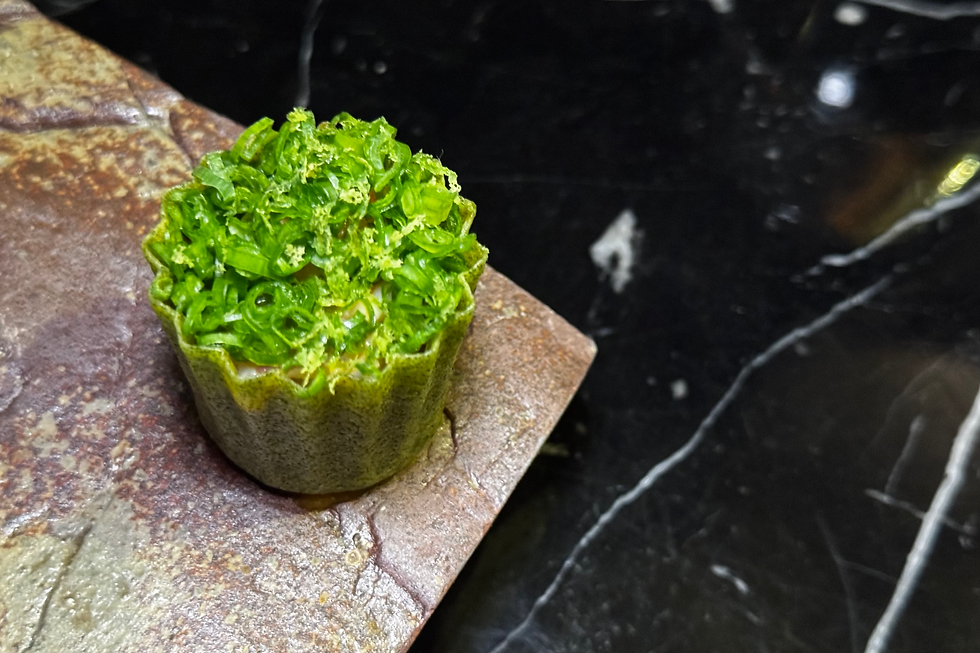
The Wolffia Croustade followed, filled with shrimp ceviche, yentafo sauce, dried shrimp relish, young morning glory and som saa. The delicate croustade gave way to a filling with considerably more intensity, as fresh shrimp met the concentrated savouriness of dried shrimp and the distinctive character of yentafo. Som saa introduced an aromatic citrus lift, while young morning glory brought freshness to a bite that felt unmistakably Thai despite its contemporary presentation.

The following course was originally listed as Just-Grilled Squid, but was reworked with prawn to accommodate a dietary allergy. Rather than simply replacing one seafood ingredient with another, the kitchen created a considered alternative of prawn tempura alongside grilled prawn in a clear consommé topped with thin slices of starfruit. The crispness of the tempura contrasted with the sweetness and gentle smokiness of the grilled prawn, while the consommé provided a delicate savoury foundation. Starfruit brought a clean tartness that cut through the natural sweetness of the crustacean, allowing the adaptation to stand comfortably as a complete course in its own right.

Fire became more pronounced with the Charcoal-Grilled Murex Shell & King Oyster Mushroom. The shellfish and meaty mushroom were served with fermented mushroom–tao jiew sauce, seafood XO chilli, ginger, scallion oil, and calamansi. Fermentation amplified the mushroom's earthy, savoury character, while the murex added contrasting texture. Ginger and calamansi added freshness and acidity, letting the charcoal and fermented elements stay deep without becoming overly heavy.

A gentler transition came with Steamed Mekhong Catfish in Lime-Zest Green Curry. Coconut extract, basil and caviar accompanied the fish, with the green curry taking a more restrained form than its familiar counterpart. Coconut provided roundness and basil brought its recognisable perfume, while lime zest sharpened the composition around the freshwater fish. Caviar contributed measured salinity without distracting from the catfish at the centre of the plate.

One of the dinner's most visually distinctive presentations arrived with the Black Chicken Kaeng Liang Broth, served inside a pumpkin nestled in straw. Crispy-skinned black chicken, pumpkin and goji berry accompanied the broth, drawing on the peppery and herbaceous character associated with kaeng liang. The pumpkin's sweetness softened the more savoury elements, while the black chicken added richness and texture. Despite its dramatic presentation, the course retained something inherently comforting, showing how a familiar Thai flavour structure could be dressed differently without losing its character.

Northern Lights then changed its rhythm. Instead of continuing as a succession of individually composed plates, two samrub preparations arrived at the same time, transforming the table into a collection of dishes, condiments and contrasting flavours. It was an appropriate shift, reflecting the relational nature of Thai dining, where richness, acidity, chilli, fermentation and starch are often understood through how they interact rather than in isolation.
The Samrub – Focaccia centred on charcoal-grilled river prawn on prawn claw, accompanied by preserved radish cream cheese and scallion, smoked pickled Asian pear, smoked sato-fermented fish and grilled scallion. Focaccia might initially appear an unlikely companion to these flavours, yet it worked naturally as the starch around which the other elements could gather. The sweetness and smoke of the river prawn met the richness and salinity of preserved radish cream cheese, while smoked pickled Asian pear introduced fruit and acidity. The sato-fermented fish added a deeper savoury dimension, turning the bread into a vehicle for an interplay of smoke, pickle, and fermentation rather than an incongruous addition.

Alongside it, the Samrub – Sticky Rice Wrap moved more explicitly towards Lanna, bringing together sun-dried beef tenderloin, prawn-head hollandaise, pickled grilled chilli and makwaen, crispy prawn chin, and pickled celtuce with mustard leaves. The beef's concentrated savouriness was enriched by the prawn-head hollandaise, while chilli and makwaen cut through with heat, citrusy fragrance, and the latter's characteristic gentle tingle. Pickled celtuce and mustard leaves brought freshness, and crispy prawn chin added another textural contrast. Sticky rice provided the familiar northern anchor, letting the different accompaniments combine freely rather than prescribing a particular mouthful.
Presenting the two samrubs simultaneously made their differences more meaningful. One used focaccia to carry river prawn, smoke and fermentation; the other returned to sticky rice, sun-dried beef and makwaen. Moving between them let acidity, richness, chilli, and smoke respond to one another across the table, making this stage of Northern Lights one of the clearest expressions of the dinner's dialogue between Lanna and Siam.

Dessert continued the menu's exploration of fermentation rather than abandoning it for straightforward sweetness. Candied Khai Banana paired the fruit with tua nao caramel, crispy puffed rice, candied goji berry, fermented rice–coconut foam and five spice. Tua nao, the fermented soybean ingredient closely associated with Lanna cooking, proved particularly intriguing in caramel. Its savoury depth gave the sweetness greater complexity without pushing the dessert into overtly savoury territory. Fermented rice and coconut provided a lighter counterpoint, while puffed rice introduced crispness against the softer textures of banana and foam.

The dinner concluded with three mignardises: ginger milk pudding, caramel Chinese cruller and egg custard coffee. After a progression shaped by fermentation, smoke and assertive aromatics, these final bites offered a gentler finish. Ginger brought warmth to the milk pudding, the cruller found pleasure in the familiar combination of fried dough and caramel, while egg custard and coffee closed the evening with richness and a touch of bitterness.
What made Northern Lights particularly engaging was its reluctance to make its Lanna identity overly obvious. Chef Nan's Chiang Mai perspective emerged through ingredients and processes rather than a parade of recognisable northern dishes: makwaen providing fragrance, tua nao becoming caramel, sato entering a fermented fish preparation, and preservation, smoke and charcoal recurring throughout the meal. Chef Thep's approach at TAAN provided the other side of the conversation, allowing these references to move into new contexts. Prawn-head hollandaise could accompany makwaen and sticky rice, focaccia could carry smoked sato-fermented fish, and caviar could find its place in a lime-zest green curry. The simultaneous samrub presentation brought those ideas together particularly well, returning an otherwise contemporary tasting menu to the convivial logic of the Thai table.

Ultimately, Northern Lights by TAAN Bangkok succeeded because the four-hands format felt less like two chefs taking turns than a genuine exchange between two culinary perspectives. Chef Nan brought Cuisine de Garden's Chiang Mai roots and Lanna vocabulary to Bangkok, while Chef Thep responded through TAAN's exploration of Thai ingredients and traditions. At TAAN Bangkok, Lanna and Siam met not by asking one to imitate the other, but by finding common ground through fire, fermentation, preservation and the pleasure of sharing food at the same table.
TAAN Bangkok
Tel: +666 5328 7374
Website: https://www.taanbangkok.com/main/
Instagram: https://www.instagram.com/taanbangkok
Facebook: https://www.facebook.com/taanbangkok
Email: contact@taanbangkok.com
Location: 865 Rama I Road in Pathumwan, Bangkok
Credits
Article: Wariya Intreyonk
Photos: Wariya Intreyonk


Comments