Electric Sheep Bangkok Dreams of a More Human Table


There was a period when sustainability became one of hospitality's most persuasive words. Restaurants spoke eagerly of greener kitchens and a better future, while diners became increasingly interested in the consequences of what they ate. Much of that enthusiasm was well-intentioned, although the language occasionally outpaced the practices behind it. Distinguishing genuine commitment from a carefully polished claim was not always straightforward.

Electric Sheep takes a quieter approach. Open since October 2024, the restaurant is located inside The Warehouse, a lively community hub occupying a historic building in Talat Noi. It does not make sweeping promises about saving the world. Instead, it considers what can reasonably be changed within its own kitchen, supply chain and relationship with its guests.
Behind Electric Sheep are Chefs Amerigo Tito Sesti and Yoan Martin, who previously worked together at J'AIME by Jean-Michel Lorain. After helping the restaurant earn a MICHELIN Green Star, they eventually stepped away from the polished world of fine dining to create something more grounded, comfortable, and accessible beneath the colourful neon lights of their own dining room.

"Yoan and I had already been working in Thailand for quite some time when we were at J'AIME," says Sesti. "Our journey towards sustainability began there, particularly after we read 'Silo: The Zero Waste Blueprint'. The book challenged us to reconsider the way we worked. Little by little, we began sourcing more ingredients locally, reducing waste and introducing many of the practices that eventually helped J'AIME earn a MICHELIN Green Star.
"However, we also realised that there were limits to what we could achieve within the context of J'AIME and the hotel. If we wanted to take our ideas further, we needed to create a place of our own. That was how we began developing Electric Sheep."

Sesti is Italian, and Martin is French. Both bring their own culinary education and cultural references, but Electric Sheep was never intended to reproduce European cooking in Bangkok without considering its surroundings.
"Regardless of our nationalities and combined experiences, we must adapt them to the local terroir," Sesti explains. "Using local ingredients was our first rule. From there came a series of questions: What should we cook? Should we simply cook what we already know? How could we reinterpret our experiences through ingredients found here? Those questions gradually shaped Electric Sheep into what it is today."

The restaurant takes its name from Philip K. Dick's 1968 dystopian novel 'Do Androids Dream of Electric Sheep?', which became the basis for 'Blade Runner'. Rather than serving as a convenient science-fiction reference, the artificial world Dick imagined gave the chefs a language to examine contemporary urban life and humanity's increasing distance from nature.
"The name and concept reflect the world we live in today and the direction in which we are moving—a world of unbreathable air, disappearing trees and an increasing presence of artificial intelligence," Sesti says. "We humans are moving further and further away from nature. Many people no longer know where their food comes from or fully understand what they consume; it simply arrives in front of them.

"Fortunately, we are not living in that dystopian world yet, but when we look at Bangkok and other major cities, we can see ourselves moving towards it. That connection between an artificial future and a lost natural world became part of the thinking behind Electric Sheep."
For Sesti and Martin, nature does not refer only to plants, animals or ingredients. It also encompasses the human instinct to gather and share food.

"We wanted to express something we believe has been lost: nature in its many forms," Sesti continues. "That means nature as ingredients, nature as a way of living and also our natural instinct as human beings to be social.
"As the concept developed, we realised that we wanted to move away from fine dining. Eating should be a moment of sharing and coming together, without too many formalities interrupting that social connection. Since the beginning of human history, people have gathered around a fire to be together and to eat. Those are the origins of food and society, and we wanted Electric Sheep to move closer to them."

Choosing a casual format also allowed the chefs to make their ideas relevant to a broader audience. Fine-dining restaurants may possess greater resources and more opportunities to experiment, Sesti observes, but their prices and formality inevitably limit whom they reach.
"There are far more casual restaurants than fine-dining restaurants around the world, so it was important for us to demonstrate that operating sustainably is not only feasible within fine dining," he says. "It can also be done in an everyday restaurant and made accessible to a broader group of people."

The less formal setting has shortened the distance between the chefs and their guests. Many arrive with an existing interest in sustainability or an appreciation for local ingredients, while others become curious through the meal itself.
"One of the most interesting results has been the stronger connection we have developed with our guests," Sesti explains. "The relationship feels more natural because there is no longer the distance that can sometimes exist between diners and chefs in a fine-dining restaurant.

"I do not know whether it is the concept, the location or a combination of the two, but we have been very fortunate. Many of the people who come here are sensitive to sustainability, curious to learn more or proud that we use local ingredients. That creates a dialogue, which is precisely what we wanted: a conversation that could gradually develop into a community."
The same desire for a more direct connection shapes the cooking. Complexity has not disappeared, but it is no longer presented as an achievement in itself. Technique remains where it improves an ingredient, preserves a surplus or makes something more enjoyable.

"The food has become more straightforward," Sesti says. "We are not overly concerned with aesthetics, unnecessary complexity or adding textures simply for the sake of it. We ask how simple and natural the food can be while still avoiding waste throughout the process.
"When we think about what we eat every day, what we ate as children, meals shared with our families or traditional cuisines in general, the food is usually simple. Across cultures and throughout human history, food developed this way for a reason. Perhaps that tells us something about how food is meant to be."

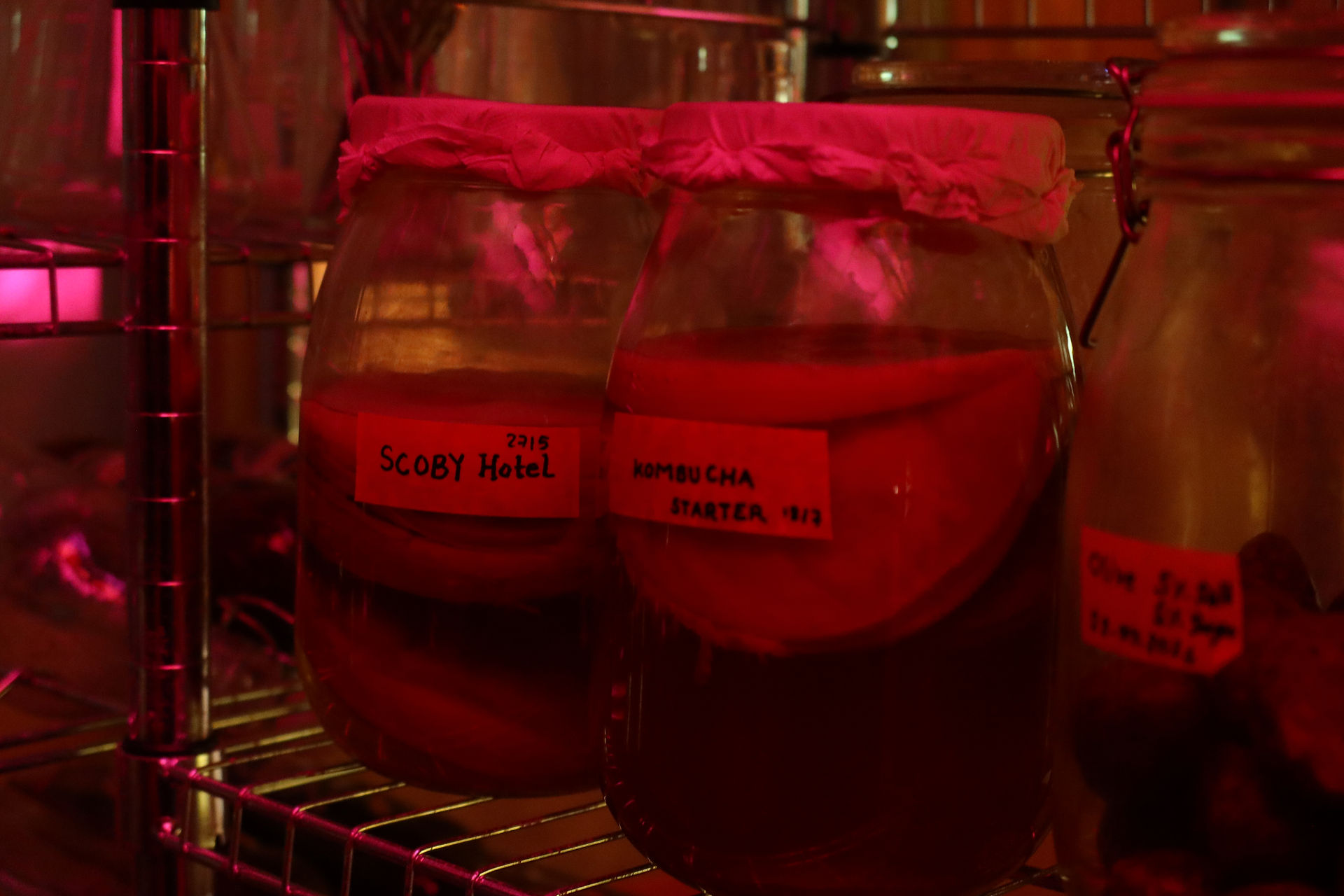

These principles become tangible in Electric Sheep's fermentation room, overseen by Nawin Namkaew. Given the freedom to explore, Nawin works with everything from familiar produce to exotic and nearly forgotten ingredients, as well as kitchen surpluses that might otherwise be overlooked. Different fermentation methods extend their useful lives while revealing new flavours, textures, and applications. The room operates as both a practical response to waste and a creative laboratory, allowing the kitchen to consider not only how an ingredient might be preserved, but what else it might become.


The chef's tasting menu brings those ideas to the table through European references, Thai produce and fermentation, while keeping pleasure at its centre. Local speck and Pha-Nom-Yen cheese arrive on house-made flatbread with caramelised shallots, followed by crisp Thai aubergine frittella with salsa verde and pla khem. Bonito is paired with sweet-pepper gazpacho, wild aubergine and tiger ears, while ginger and tiger-prawn tartare is sharpened by spring onion and balanced with rouille. A course originally combining squid roe, oyster mushrooms, macadamia and coriander was adapted for an allergy by replacing the roe with grilled lion's mane mushroom, its dense texture making the change feel considered rather than merely accommodating.


The menu then moves towards fuller flavours with Ayutthaya lamb, fermented harissa and cooling coconut yoghurt, followed by spinach maccheroni with coconut ricotta and house-made katsuobushi. Khao Yai chicken with cured lemon and chermoula provides the final savoury course, before Chiang Mai chocolate, lemon-basil sorbet and cocoa-nib vinegar close the meal with richness, fragrance and measured acidity. The sequence is interesting not because every plate loudly announces its sustainability, but because the philosophy has already been absorbed into the cooking.

Outside the tasting-menu sequence, the kitchen shared a ravioli that was still in development. Made with rice flour and unripe Namwa banana flour, it enclosed coconut yoghurt and Italian basil, accompanied by a sauce of chilli, ginger and yellow aubergine with an almost caper-like quality. Rather than presenting it as a finished course, the preview offered a glimpse into Electric Sheep's ongoing experimentation and its willingness to allow an idea to evolve.
Local ingredients are not included merely to prove their provenance, fermentation is not employed as a fashionable flourish, and coconut yoghurt is not treated as a reluctant substitute for dairy. Each is used because it contributes something worthwhile to the dish.

Electric Sheep does not claim that one restaurant can save the world. Although sustainability may no longer command the same fashionable attention it received between 2019 and 2021, Sesti, Martin and their team continue to practise what they believe in. Their convictions are present in a fermentation room where overlooked ingredients acquire new possibilities, in a kitchen willing to adapt and in a dining room where the distance between chefs and guests has deliberately been shortened.
Electric Sheep may take its name from a dystopian vision of a world estranged from nature. Still, its response is reassuringly human: cook thoughtfully, waste less and give people a reason to gather around the table.


Comments